Invoicing & Payment


About
One of the final documents exchanged in the Buy-Ship-Pay process, the invoice was one of the first to be digitalised thanks to the efforts of OEM finance managers whose accounts payable departments were disappearing under a mountain of paper. It was the digitalisation of the invoice document that led these early pioneers to get together to form the Odette organisation to build on this success.
But why not simply pay for the parts you receive rather than expect the supplier to create an invoice? In fact, several customers in the automotive industry have gone down the road of Self-Billing where they create the Invoice themselves based on what they have received or consumed.
For production parts, the Invoice message is closely related to the Despatch Advice message and like the Despatch Advice is under constant review by Odette and its JAIF partners. Changes to the Despatch Advice message are largely driven by advances in logistics processes, whereas changes to the Invoice message are more often driven by legislation.
The final message in the automotive Buy-Ship-Pay process is the Remittance Advice, which is sent by the customer to the supplier to advise that payment has been made to the supplier’s bank account and finally close the loop. Again, Odette has worked with its JAIF partners to develop a digital Remittance Advice that satisfies the requirements of the global industry.
-

news
MMOG: Strengthening Supply Chain Management Capability and Performance
As automotive suppliers worldwide prepare for upcoming MMOG assessment cycles, the MMOG assessment tool—developed jointly by Odette and AIAG—continues to serve as the de-facto standard process automotive companies rely on to assess logistics capability, operational performance and supplier readiness.
-
news
European E-Invoicing: Latest Updates on ViDA and CEN Standards Work
As the EU's VAT in the Digital Age (ViDA) initiative moves towards implementation and Digital Reporting Requirements (DRR) continue to evolve, automotive companies face a rapidly changing e-invoicing landscape. Recent discussions within the Odette invoicing community highlighted key developments in European standards work, national implementation programmes and ongoing efforts to maintain interoperability across diverse invoicing environments.
-
news
Odette Invoice Viewer & Converter Supports E-Invoicing Readiness
As electronic invoicing requirements continue to expand globally, an increasing number of companies are required to receive invoices in structured electronic formats, often based on the CEN EN 16931 standard.
Initiative
Invoice Viewer & Converter
An increasing number of EU member states are obliging their companies to be able to receive invoices in a structured electronic format (often according to the EN16931 standard invoice).
This tool can take invoices which have been created in accordance with EN 16931 and display them in a human-readable format. As part of this process any invoices which were originally created using the OASIS UBL format are converted to the CEFACT Cross Industry Invoice (CII) format.
User groups:
- *Users whose company still generally receives electronic invoices in an unstructured format and process them manually. The tool can be used to generate an invoice image (PDF) from invoices created in accordance with EN 16931. This image can then be used for further, possibly manual, processing and internal invoice verification.
*Users whose company can already receive and process structured invoices in CII format (e.g. the structured content of ZUGFeRD or Factur-X invoices), but who now also need to be able to receive and process invoices which were originally created in UBL format.
Invoice Viewer & Converter
This tool, developed and provided free of charge by Odette, takes xml invoices created in accordance with EN 16931 in either OASIS UBL syntax or CEFACT Cross Industry Invoice (CII) syntax and displays them in a human-readable format. It also converts invoices from UBL syntax to CII syntax for import to applications which support CII.
Resources
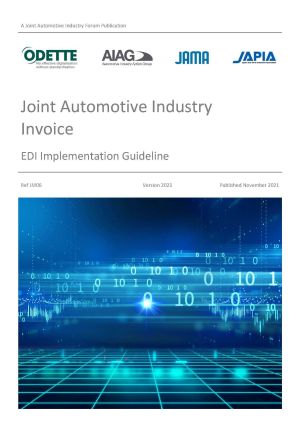
Joint Automotive Invoice Message
EDI Implementation Guideline
INVOIC
Based on EDIFACT D.07A - Syntax v4
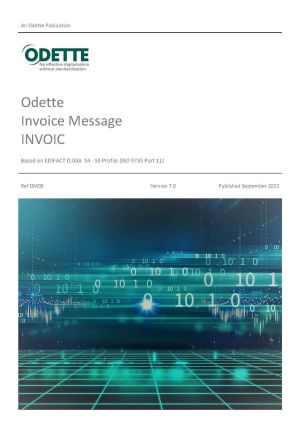
Odette Invoice Message
EDI Implementation Guideline
INVOIC
Based on EDIFACT INVOIC D.03A - Syntax v4
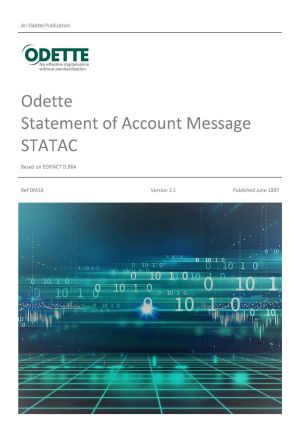
Odette Statement of Account Message
EDI Implementation Guideline
STATAC
Based on EDIFACT STATAC D.96A - Syntax v4
Joint Automotive Remittance Advice Message
EDI Implementation Guideline
REMADV
Based on EDIFACT D.04A - Syntax v4
(File must be opened with Adobe Acrobat to access attachments)
Odette Remittance Advice Message
EDI Implementation Guideline
REMADV
Based on EDIFACT REMADV D.96A - Syntax v4
Odette Application Error and Acknowledgement
EDI Implementation Guideline
APERAK
Based on EDIFACT APERAK D.08A - Syntax v4
This message supports automated error handling for incoming EDI messages such as Despatch Advice or Invoice, including:
- Acknowledgement of receipt of the incoming message
- Reporting of syntax errors which prevent further processing.
- Reporting of actual data errors
Invoice Viewer & Converter
This tool, developed and provided free of charge by Odette, takes xml invoices created in accordance with EN 16931 in either OASIS UBL syntax or CEFACT Cross Industry Invoice (CII) syntax and displays them in a human-readable format. It also converts invoices from UBL syntax to CII syntax for import to applications which support CII.